

I, like many women I know, learned young how to make small compromises in relationships.
I was told to “be nice” and “have empathy.” Neither was bad advice; although, I do prefer being kind over being nice, but still feel it’s important to possess empathy for others. As a kid though, I became quite proficient at understanding what other people needed long before I understood that doing so didn’t require me to move away from myself.
And this isn’t limited to just romantic relationships either.
Some of my earliest experiences of it happened within my own family as a kid. These were the people closest to me, which meant their feelings mattered enormously. Their disappointment and approval mattered. Keeping the relationship intact mattered. I learned how to read the room, make adjustments, let certain things go, and accommodate what other people needed.
It’s important to note that it wasn’t like a hostile takeover or anything. I wasn’t non-existent or disappearing. I had my opinions, ambitions, interests, and ways of being.
I was just moving. A degree here and another there.
I might concede something that didn’t seem all that important or adjust a preference because I cared more about harmony than getting my way. Let something go because, really, was it worth the tension or drama? Each choice made sense on its own and many of them probably were healthy compromises.
But patterns formed, and because our earliest relationships teach us something about what closeness feels like, I carried some of those patterns with me as I grew. They showed up differently with friends, romantic partners, and other people I allowed into my inner circle.
If anyone had ever asked me whether I was changing myself for a relationship, my response would have been “hell no.” I probably would’ve side-eyed that person and felt a little insulted, too.
Back then, to me, none of those choices, on their own, constituted self-abandonment. Most of them probably weren’t, but that’s what makes the distinction so difficult.
Fragmentation didn’t require an enormous betrayal of who I was. It happened by degrees.
I’ve written before in this series on what can happen when we move only one degree away from ourselves. At first, the separation is nearly imperceptible because one degree doesn’t feel like much. It’s only after we’ve drifted for a while that we can look back and see how far our trajectory has shifted.
Some of my earliest experiences of fragmentation in relationships worked like that. Just a series of one small compromise after another until, eventually, I would find myself wondering, “wait, how the fuck did I get here?”
I remember noticing something particularly strange after relationships ended when I was younger, too. Alongside whatever sadness or disappointment I felt, there was often a welcomed sense of relief.
I was relieved because suddenly all those little decisions belonged entirely to me again. I could just be me and do what I want without having to consider someone else. That feeling bothered me; it made me wonder why being completely myself seemed easier when no one was close enough to require anything of me.
What made even less sense was that I didn’t seem to have this problem everywhere. I had good boundaries with acquaintances and could say no to strangers. I could disagree with people who existed comfortably outside my inner circle.
The closer someone got to me, however, the more leeway I gave them and the more willing I became to move those tiny degrees away from myself. It was so damn backwards.
Or… maybe it wasn’t because the closer someone is, the more there is to lose.
A colleague can be disappointed in me and I can live with that. A stranger can misunderstand me and I’ll probably survive, but someone I love and care about? Someone whose presence in my life matters deeply? Their disappointment carries a weight that’s much heavier.
Some of that came from navigating my childhood relationships, some from my personality and desire for harmony, and some from absorbed ideas about what women were supposed to be in relationships without realizing I had learned them. I’m sure there are additional pieces to this that I still don’t fully understand.
What matters to me now is that somewhere along the way, closeness became entangled with accommodation. And because accommodation usually looks like kindness, generosity, empathy, or compromise, it was remarkably easy to mistake fragmentation for love.
That distinction took me much of my twenties to understand.
Healthy relationships require compromise. Loving another person means their preferences sometimes matter more than mine. It means changing plans, making room, being inconvenienced, giving something up because it matters more to someone I love than it does to me. There are seasons when one person carries more because the other simply cannot. I don’t want a version of wholeness so rigid that no one is ever asked to bend.
Love asks us to bend.
The question is whether we can bend without slowly becoming unrecognizable to ourselves.
Maybe that’s the difference I couldn’t articulate when I was younger. A compromise changes something I do. Fragmentation, when repeated often enough, begins changing the relationship I have with myself. Sometimes the individual choices are so small that the only way to see what is happening is to stop dissecting each decision and look at the direction of travel instead.
Am I always the one adjusting?
Are there things I no longer ask for because I already know the answer?
Have I become so good at anticipating someone else’s needs that I’ve stopped checking for my own?
Do I feel more like myself when they aren’t around?
That last question would have told younger me a whole hell of a lot.
It took time, and plenty of getting it wrong, to learn how to remain whole while being deeply connected to someone else. I had to learn that disagreement did not necessarily signal danger and that another person’s disappointment wasn’t automatically mine to fix. That empathy could allow me to understand someone’s experiences without requiring me to make it my own, and that love could survive a no.
I know what that feels like now.
With my husband, Joerg, I am fully myself. Not an unchanging or uncompromising version of myself, but a whole one. I have my preferences, can disagree, can need space, can change my mind, can say what I actually think, and can take up room in our relationship without wondering whether doing so threatens it.
I can be completely silly, ridiculous even, with my amateur SNL-esque comedy bits and various accents and bogus dance moves. I love that all parts of me are loved fully and without expectations of being anyone or anything but myself.
His love isn’t fragile and I fucking love him for that.
I’ve spent so many years learning how not to fragment myself in relationships, but now I notice something else…
Sometimes, I notice Jeorg doing it.
He is so devoted to me and our daughter. He loves us fiercely and his instinct is often to accommodate us. He wants us happy, so he makes room, he adjusts, and he gives. I adore his genuine love for his girls; it’s one of the things I love most about him, but sometimes I have to tell him to stop.
Joerg, go to the gym. Watch the Bundesliga. Do what you wanted to do. We’re fine, lovie.
It’s so important that when I see him fragmenting, I tell him to stop because I don’t want his beautiful devotion to us to slowly consume the things that belong specifically to him. I don’t want the family we’ve built to flourish because he has made himself smaller inside it.
There’s something almost funny about finding myself on this side of the equation after spending so much of my younger life trying to understand the other one.
For years, I thought the work was learning not to abandon pieces of myself for someone I loved. It was, but that was only half of it.
The other half was learning not to accept someone else’s self-abandonment as evidence of how much they love me.
I don’t want to be loved at the expense of the person loving me.
There is much talk about boundaries in society today, and much of that conversation has been necessary. Many of us needed to learn language for saying no, protecting our time, and recognizing when access to us had become entitlement, but boundaries alone cannot tell us how to love one another.
A relationship can’t simply be two fiercely independent people protecting their respective territory. Intimacy does require permeability. We are supposed to affect each other, make room for one another, sometimes inconvenience ourselves, other times sacrifice, and sometimes one person’s needs really should take precedence for a while. The goal cannot be to remain completely untouched by one another.
Perhaps relational coherence is more complicated.
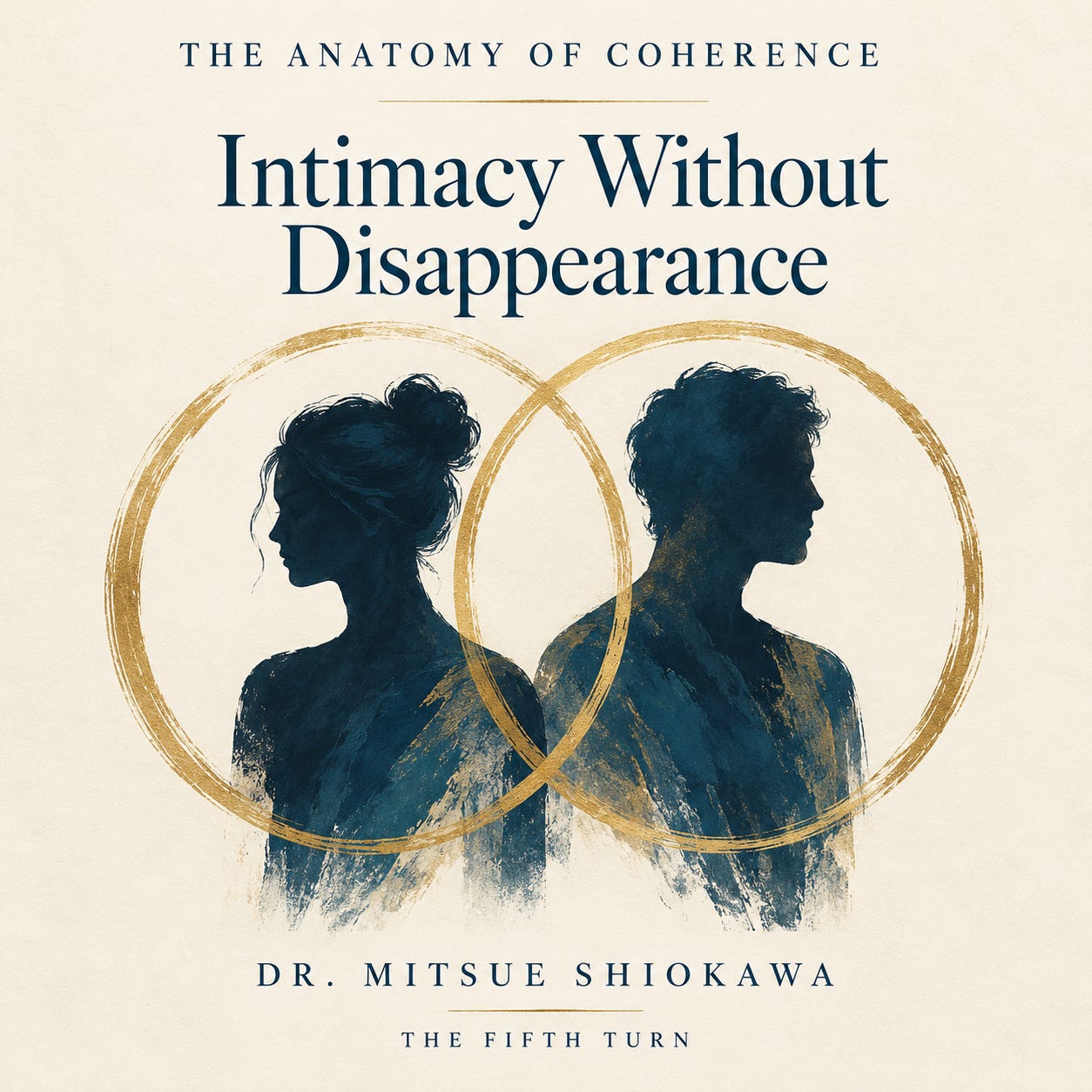
There is a me. There is a you. And there is an us. All three require care.
Sometimes me gives something for us. Sometimes you do. Sometimes one of us gives far more for a season because life doesn’t divide burdens evenly. But, if us can exist only through the repeated fragmentation of me or you, something has gone wrong.
I understand that differently now than I did as a kid and young adult. I used to think a strong relationship was one that could be preserved. In so many ways, that made its fragility frightening. If telling the truth, saying no, needing something different, or taking up too much room might threaten the relationship, then perhaps the safer choice was to move a degree.
Then another… and another…
But, you know what? Fuck it. If a relationship is so fragile that either of us has to continually fragment ourselves to preserve it, I don’t want it anyway.
I don’t mean that defiantly. I don’t mean relationships should be disposable, or that every difficult compromise means that we are betraying ourselves. I believe quite the opposite.
I want relationships sturdy enough to withstand the truth. Sturdy enough for two people to remain recognizable to themselves. Sturdy enough for me to notice when someone I love is giving too much and say, “You don’t have to do that to stay close to me.”
Perhaps that is what I was trying to learn all those years ago. Not how to protect myself from intimacy, but how to experience intimacy without disappearance.
I don’t need the people I love to become smaller so there can be room for me. And I no longer believe I have to become smaller so there can be room for them.
There has to be room for both of us.
The Anatomy of Coherence is an ongoing essay series about the small ways we move away from ourselves and what it takes to find our way back. If this gave you something to think about, subscribe to join me for the next one.